From Shell Companies to Crypto Mixers: OSINT Techniques to Unmask Hidden Beneficial Owners
In today's interconnected global financial landscape, illicit actors increasingly rely on layered corporate structures and advanced digital tools to conceal the true ownership of assets and funds. Shell companies, offshore entities, and cryptocurrency mixers serve as primary mechanisms for obscuring ultimate beneficial owners (UBOs)—the natural persons who ultimately own or control an entity. Open Source Intelligence (OSINT) has emerged as an indispensable methodology for intelligence professionals, law enforcement, and compliance teams to pierce through these obfuscation layers, revealing hidden networks and enabling proactive threat mitigation.
Knowlesys Open Source Intelligent System stands at the forefront of this capability, providing law enforcement and intelligence agencies with a comprehensive OSINT platform that supports intelligence discovery, alerting, analysis, and collaborative workflows essential for tracing complex financial trails.
The Challenge: Hidden Beneficial Ownership in Modern Financial Crime
Ultimate Beneficial Owners are the real individuals who benefit from or control a company, even when legal ownership is registered under nominees, trusts, or shell entities. Criminal networks exploit these structures to facilitate money laundering, sanctions evasion, tax fraud, and corruption. Shell companies—entities with no significant operations—often form the foundation of such schemes, while cryptocurrency mixers add a digital layer of complexity by breaking transaction trails on public blockchains.
Investigators face multi-jurisdictional opacity, nominee directors, and privacy-enhancing technologies. Yet, through systematic OSINT application, these barriers can be systematically dismantled, transforming fragmented public data into actionable intelligence chains.
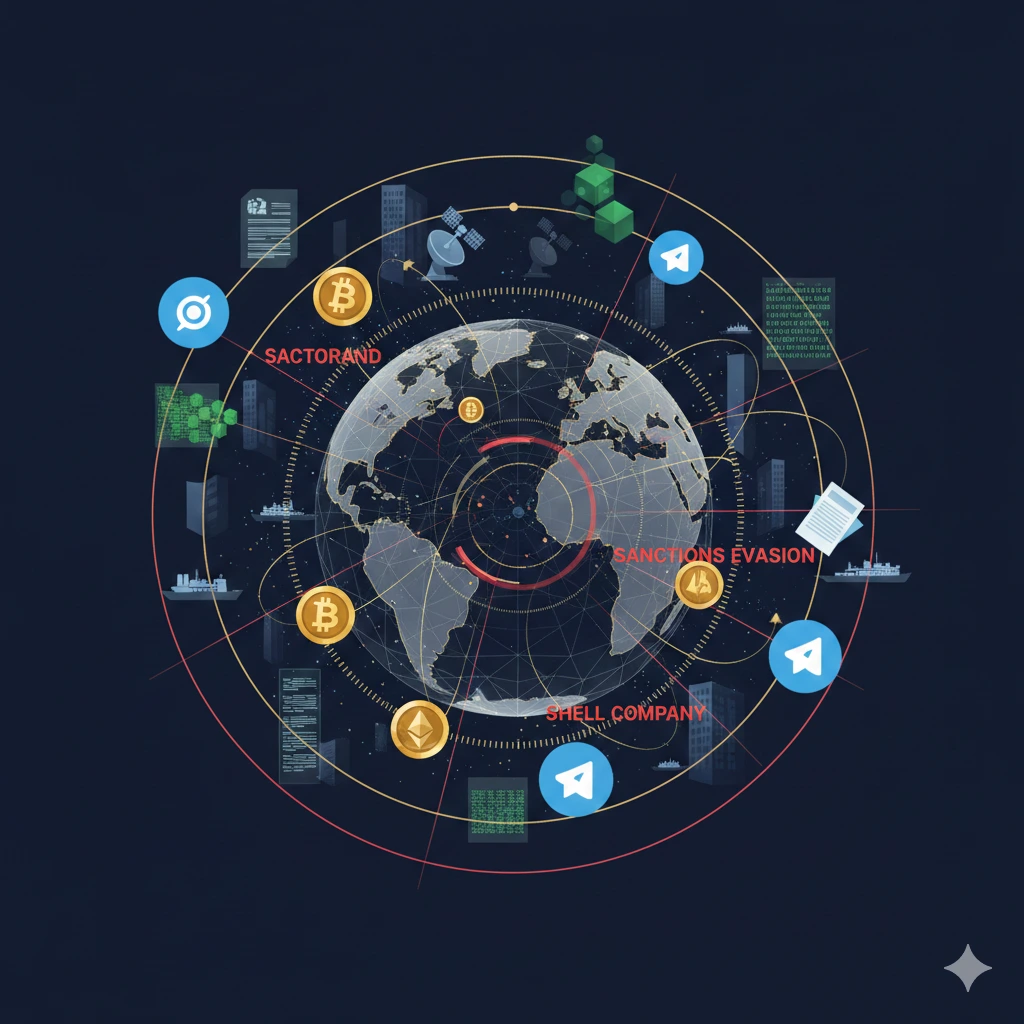
This diagram illustrates the layered complexity often encountered in beneficial ownership tracing, highlighting the need for robust analytical tools to map connections effectively.
OSINT Techniques for Unmasking Shell Company Ownership
Tracing beneficial ownership begins with corporate registries, leaks, and public records. Key OSINT methods include:
- Corporate Registry Searches: Accessing public databases such as OpenCorporates, UK Companies House, or equivalent national registers to identify directors, shareholders, and filing histories. Red flags include nominee directors, rapid incorporations, and addresses shared with hundreds of entities.
- Ownership Chain Mapping: Following shareholding layers backward until a natural person emerges. Tools visualize these structures, revealing loops or offshore havens designed to obscure control.
- Adverse Media and Network Analysis: Cross-referencing names with sanctions lists, news archives, and professional networks to uncover associations with high-risk individuals or jurisdictions.
- Document Leak Integration: Leveraging historical leaks (e.g., Panama Papers) enriched with current OSINT to validate connections.
These techniques expose how shell companies serve as conduits for illicit flows, often linked to real estate, luxury assets, or financial transactions.
The above visual representation demonstrates typical shell company structures used in money laundering schemes, emphasizing the importance of systematic tracing.
Transition to Digital Obfuscation: Crypto Mixers and Blockchain Challenges
As traditional financial trails become more scrutinized, perpetrators increasingly route funds through cryptocurrencies. Mixers (tumblers) aggregate and redistribute transactions, severing direct links between source and destination addresses. Additional methods include chain-hopping across blockchains, privacy coins, and nested services.
Despite pseudonymity, blockchain's public ledger provides OSINT opportunities:
- Transaction Graph Analysis: Identifying patterns like peeling chains or mixer interactions through clustering algorithms.
- Off-Chain Correlation: Linking wallet addresses to real-world identities via exchange KYC data, social media, forums, or public announcements.
- Attribution via Known Entities: Flagging interactions with regulated exchanges, darknet markets, or sanctioned addresses.
- Behavioral Profiling: Detecting anomalies such as high-frequency small transfers indicative of mixing activity.
Knowlesys Open Source Intelligent System enhances these efforts by enabling real-time discovery of related discussions, account behaviors, and multimedia content across global platforms, supporting analysts in correlating on-chain and off-chain intelligence.
This illustration depicts blockchain transaction tracking methodologies, crucial for overcoming mixer obfuscation in cryptocurrency investigations.
Integrated OSINT Workflows: Bridging Shells and Crypto
Advanced investigations combine corporate and blockchain OSINT:
- Identify shell entities through registries and adverse media.
- Trace fund flows to crypto wallets via exchange records or leaks.
- Analyze mixer interactions using blockchain tools.
- Correlate with social media, forums, and KOL networks for identity attribution.
- Build knowledge graphs to visualize collaborative patterns.
Knowlesys supports this full lifecycle with AI-driven analysis, including subject profiling, propagation tracking, and false account detection—capabilities vital for identifying coordinated efforts behind hidden ownership structures.
Conclusion: Empowering Intelligence Through Comprehensive OSINT
Unmasking hidden beneficial owners demands persistent, multi-layered OSINT application—from corporate transparency tools to blockchain forensics. As obfuscation techniques evolve, platforms like Knowlesys Open Source Intelligent System provide the intelligence discovery, alerting, and analytical depth required to stay ahead. By delivering precise, evidence-based insights, these technologies enable authorities to disrupt illicit networks, safeguard financial systems, and uphold global security.
With over two decades of expertise in OSINT innovation, Knowlesys continues to equip professionals with the tools needed to convert vast open-source data into decisive intelligence advantage.